|
GENERAL INFORMATION 2007-2008
|
THE
COLLEGE
Shoreline Community
College offers excellent
academic, professional/technical and work force
training programs to meet the lifelong learning
needs of its community. Dedicated faculty and staff are
committed to the educational success of all students.
Located 10 miles north of
downtown Seattle,
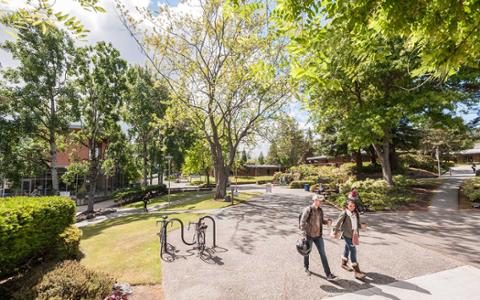
Shoreline is one of the most strikingly beautiful college
campuses in Washington. Nestled among native evergreens,
the campus is a brilliant sea of colors during
spring, summer and fall, when many flowering plants are
in bloom. The scenic surrounding area is nationally
known for its recreational
and cultural opportunities,
which richly complement academic life. Twenty-six
buildings constitute the 83-acre campus. These include
an award-winning automotive training center, a visual
arts building, computer centers, laboratories, a student
center, a theater, a well-equipped gymnasium that
includes an exercise room and racquetball courts, a child
care center, a sophisticated multimedia center and the
Ray W. Howard Library/Technology Center.
Established in 1964, Shoreline operates under the regulations
of the State Board for Community and Technical
Colleges and is governed by the Board of Trustees of
Shoreline Community College, District Number Seven.
The college is a member of the American Association
of Community Colleges and the Association of
Community College Trustees.
Shoreline's satellite campus, SCC at Lake Forest Park,
provides academic transfer courses and computer certificate
programs as well as customized training. The
Center, located in Lake Forest Park Towne Centre, features
state-of-the-art technology labs and newly furnished
classrooms.
SCC AT LAKE FOREST PARK
Lake Forest Park Towne Centre
17171 Bothell Way NE, Suite A220
Lake Forest Park, WA
Shoreline Community
College also offers educational
opportunities to the local community with its satellite
campus, the Shoreline Community College, Lake Forest Park. Shoreline Community College, Lake Forest Park is located in the Lake Forest
Park Towne Centre and was established in 1990 to serve
the eastern portion of the College's district. The extension
campus consists of six classrooms and computer labs,
a testing center, a conference room, and office space.
Shoreline Community College at Lake Forest Park's
mission is to meet the lifelong learning and workforce
development needs of its diverse community. As such,
Shoreline Community College, Lake Forest Park offers a variety of credit classes, continuing
education and computer certification classes, community
service classes, and customized training. In addition, the
Work Skills Assessment Center provides state-of-the art
testing and training programs for area businesses, individuals
and organizations. Shoreline Community College, Lake Forest Park's training programs
and testing services are aimed at developing the skills of
the local workforce.
RAY W. HOWARD
LIBRARY
The
Library/Technology Center plays an influential role
in providing instruction and instructional support to students
and faculty across all college programs. The recently
renovated building provides a variety of individual and
group study areas including a state-of-the-art information
and research classroom/lab and a 100+ seat open computer
lab. The various service areas and reading rooms house
a collection of more than 77,000 books, periodicals,
videos, DVD/CDs and other non-print media. All new
equipment, furnishings and study areas provide students
with a building well suited for research and learning in
the 21st century.
Technology is featured on the first of the building's
three floors. The student computer lab is open
seven days a week during the fall, winter and spring quarters
and contains current versions of standard and specialized
software installed on new computers and scanners.
A television/ITV studio is also available for video production
and editing. The interactive television service provides
a two-way, full motion video/audio capability that
enables the college to be linked to other colleges, government
agencies and businesses in the United States and
around the world. A video editing lab for students is
adjacent to the television/ITV studio.
The second and third floors of the
Library/Technology Center house library and media collections
and services. The Library features an online catalog, many full text periodical and reference databases,
a home page (www.shoreline.edu/library/)
with
reviewed web sites, online reference services, research
tutorials, links to other libraries and distance learning ser-
vices. In addition to quiet, comfortable reading/study
areas, there is an information/research and media classroom,
24 public access computer terminals, copy
machines, group study rooms equipped with media playback
units and distributed data jacks for connection to
the campus network. Additional Internet connectivity is
available through the building’s wireless network.
High-end
multimedia computers available for playback or
video production, digital cameras and other media equipment
are available for student use.
Friendly faculty and staff are available throughout the
building to assist you with your research, information
and technology questions. Our librarians and media coordinator
provide both general and subject-specific information
as well as research and media literacy instruction
for students and faculty. Look for courses offered by this
division under Informatics and Library in the course
description section of this catalog. Information about the
various services and collections of the Library/Technology
Center may be obtained by calling (206) 546-4556.
SCC WEBSITE
The official website
address of the College is
www.shoreline.edu .
The website contains information that is helpful
to students and should be consulted often. The
College uses the website to deliver online classes, post
grades, register students, sell books, and more.
Announcements regarding changes to polices and programs,
publicity for events on campus, and more are
posted on a regular basis. ACCREDITATION
Shoreline Community College is
accredited by:
Northwest Commission on Colleges and Universities
8060 165th Avenue North East, Suite 100
Redmond, WA 98052
Specific programs are accredited by
the National League
for Nursing Accrediting Commission, the American
Dental Association, the American Dietetic Association,
Commission on Accreditation of Health Informatics and
Information Management Education and the National
Accrediting Agency for Clinical Laboratory Sciences.
The Automotive Program is accredited by the National
Automobile Technicians Education Foundation.
COLLEGE
AND COMMUNITY
Shoreline Community
College is dedicated to meeting
the post-secondary educational needs of its community.
The college serves more than 8,000 credit students per
quarter. Individuals may take, on a credit or an audit
basis, any class for which they meet the requirements.
The college is here to serve its community and
regularly offers continuing education classes to more than
1,200 people each quarter. Schedules
listing continuing education classes are issued quarterly.
INSTRUCTIONAL
DIVISIONS
Shoreline Community
College is organized into
the following instructional divisions: Business; Health Occupations and
Physical Education; Humanities; Intra-American Studies
and Social Sciences; and Science. Continuing Education and Contract
Training
constitutes another division, which offers noncredit
courses. Courses offered by the college generally
fall under one of these units. Each unit cooperates in the
planning and administration of the instructional programs
offered by the college.
ACADEMIC CALENDAR
Shoreline Community
College operates a year-round academic
calendar comprised of three (3) 11-week quarters
during fall, winter, and spring, and one (1) 8-week quarter
during the summer. Courses are also offered in the
evenings and weekends. Class schedules are published
each quarter listing the date, times, and locations of classes.
These schedules are available approximately four
weeks prior to the start of registration.
GENERAL
PROGRAMS OF STUDY
Shoreline Community College is a comprehensive college
that offers courses in a variety of areas to meet the
demands of local and regional communities.
The college offers courses in the following areas:
University Transfer
College courses at the freshman and sophomore levels are
offered. These courses have been designed to prepare students
for upper-division work at a four-year college or
university. The curriculum at Shoreline is rigorous and
challenging. Instructors focus on preparing students for
the high caliber of study at the four-year universities.
Career Training
Professional/Technical and Workforce Training
These programs are designed to prepare students for gainful
employment upon completing a course of study at the
college. More than 50 career training programs are now
available at Shoreline Community College. Details may
be found in the Professional/Technical Degree Programs
section of this catalog.
Worker Retraining Program
The Worker Retraining Program is a partnership between
community and technical colleges and the Employment
Security Department. The program provides funding
and other resources to enable unemployed individuals to
acquire the skills needed to return to work. This could
mean a short-term skills upgrade, or a new career path
and enrollment in a professional-technical program.
The WorkFirst Program
The WorkFirst Program provides free job training as well
as free tuition and books for parents who are receiving
cash assistance (TANF) or are considered low-income.
Currently, the program offers a variety of options and services
including a Customized Jobs Skills Training, which
prepares participants for employment with an employer
partner. The College, through partnerships with local
industry, develops short-term (22 weeks or less) training
programs designed to give students specific job skills. In
addition, WorkFirst provides funding for tuition assistance for
working parents to continue their education in SCC's
professional/technical programs. For more information, please call (206) 546-
6927.
Study Abroad
(206) 546-4627
Shoreline Community College is a regional leader in
providing short and long-term study abroad programs for
two-year college students. In addition to 10-week (one
academic quarter) programs sponsored in association with
the Washington State Community College Consortium
for Study Abroad (WCCCSA), Shoreline offers unique
three- and four-week International Summer Institute
study abroad programs around the world. Recent opportunities
have included programs in Argentina, England,
France, Guatemala, Italy, Japan, South Africa, Namibia,
Mexico, China, Greece and Turkey.
Shoreline sponsored study-abroad programs cover a
variety of instructional disciplines and feature credit-bearing
courses that are transferable to four-year colleges and
universities. Financial aid resources apply to Shoreline
sponsored study-abroad programs.
Please contact International Programs to learn more
about current study-abroad offerings at (206) 533-6676.
Parent Education Program
(206) 546-4593; (206) 546-4540
The Parent Education Program encourages parents to
develop child guidance skills and a personal philosophy
of family relations. Child development, parenting roles
in home and society and family communications are
studied in a supportive environment. Parents enroll in
the following courses: Parent Education 110, 111, 112,
120, 121, 122, 125, 126, 127, 130, 131, 132, 140, 141, 142 and 150,
151, 152. All of these are college credit courses. Up to 6
credits of Parent Education courses may be accepted
towards degree requirements at transfer institutions.
Topics explored in these courses include:
Child Development
• Social,
emotional, physical and cognitive development
• Language and
literacy development
• Multicultural
perspective
Nutrition and
Health
• Early
intervention and preventive measures
• The impact of
diet on children’s health
• Dental health
care
• Accident
prevention for children
• Available
resources
Parenting Skills
• Child guidance
strategies
• Effective
communication
• Developing self
esteem
• Values
structuring
• Impact of mass
media pressures
Family
Relationships
• Single
parents/blended family issues
• Family
communication
• Changing adult
roles and lifestyles in the family
• Parenting in our
diverse society
• Impact of
culture
Cooperative preschools are located throughout the college
district. These programs are affiliates of the college and
have varying hours depending on the number of participants.
Each preschool is a separate corporation, with
responsibility for the financing and operation of their
cooperative preschool. The college provides the instructors
for the parent education courses. The eight affiliated
Parent Education Cooperative Preschools serve parents of
children from infants through age 5. For information on
the schedules of these affiliated preschools, please call
(206) 546-4593. To enroll, contact the cooperative
preschool directly.
State Training and Registry System (S.T.A.R.S.)
(206) 546-4565
Shoreline Community College provides training and professional
development opportunities for family childcare
providers, childcare center staff, school-age directors and
staff, program supervisors, site supervisors and lead teachers.
This training and instructional development is in
accordance with the Department of Social and Health
Services' licensure requirements. In addition, the curriculum
is based on the guidelines of the Washington
Association of Education of Young Children
(W.A.E.Y.C.). Instructors who conduct this training have
been approved as S.T.A.R.S. trainers.
Childcare providers can acquire the required 20 hours
of basic training during the first six months of DSHS
licensing or the first six months of employment in child-
care by enrolling in EDU 282. The additional 10 hours
of training that is required annually by DSHS can be
acquired by enrolling in EDU 281. These courses are
offered on a quarterly basis through our Education program
and students earn college credit for these courses.
Tuition costs for this required training is reimbursed
through W.A.E.Y.C.
HIGH SCHOOL PROGRAMS
Shoreline's High School Completion Program helps students
earn a high school diploma. Adults age 18 or older
may be able to earn a high school diploma by attending classes at the college. Full-time high school students may
be able to earn a high school diploma from a high school
by attending classes at the college and transferring the
credits to that high school. For more information, call
(206) 546-6964.
GED Program
Shoreline Community College offers a low-cost General
Education Development (GED) preparation course to
help students preparing to take the GED test. Successful
completion of the test results in the awarding of a
General Educational Development Certificate. Areas of
instruction include math, spelling, punctuation, grammar
and vocabulary. In addition, the course concentrates on
reading skills in social studies, natural sciences and literary
interpretation. The GED test is given at various
times during fall, winter and spring quarters. For additional
information about GED classes, call (206) 546-
4788. For information on GED testing, please call (206)
546-4608.
Career Education Options (CEO)
The Career Education Options (CEO) Program offers
out-of-school youth a chance to go back to school for the
education and training needed to succeed in the world of
work. The program is available to 16- to 21-year-olds
who left high school without earning a diploma.
Through CEO, students enhance life skills, receive job
training and learn effective job search strategies. The
program also provides assistance with placement into
internships and employment. While in the program, students
may pursue a college degree or certificate in a professional/
technical field. Many students also simultaneously
work toward a GED certificate.
The CEO Program provides continuous support services
to help students achieve their educational and career
goals. Funded in partnership with the Office of the
Superintendent of Public Instruction, the program provides
tuition, books, supplies, transportation assistance
and tutoring to qualifying students. Additional support
services may be available on an individual basis. For
information on enrolling in CEO, please call (206) 546-
7844 or drop by the CEO office, Rm. 5222 in the 5000
(FOSS) Building.
Running Start
High school juniors and seniors may qualify to participate
in the Shoreline Community College Running Start
Program and earn college credit while simultaneously
completing their high school graduation requirements.
To qualify for the program, high school students must
take the COMPASS placement test and qualify for
English 101. Students must qualify for Math 110 and
English 101 if they wish to take any math courses or any
science courses for which math is a prerequisite.
To receive a free COMPASS testing appointment,
submit an admission application and an official copy of your high school transcript directly to the Running Start
Office in the 5000 (FOSS) Building. For additional
information on the Running Start Program, call (206)
546-6964.
Tech Prep
The Tech Prep Program offers high school students the
opportunity to prepare for Professional/Technical degrees
and to complete college equivalent classes while still in
high school. An agreement is prepared between the high
school and college faculty that ensures that credits taken
in high school and college are transferable between programs.
If you enter this program, you will get a solid
start on a community/technical college certificate or
degree, earning college credit while completing your high
school requirement.
Students who complete a Tech Prep class while attending
high school with a grade of "B" or better and have
submitted a Tech Prep application to the North East Tech
Prep Consortium will receive a college transcript from
either Shoreline Community College or another North
East Tech Prep Consortium member college: Bellevue
CC, Cascadia CC, Edmonds CC and Lake Washington
Technical College. For additional information, call (206)
546-7852, or go to www.techprep.org.
COMMUNITY EDUCATION PROGRAMS
Adult Basic Education (ABE)
Low-cost courses in reading, writing, study skills and
mathematics are designed to help students improve their
skills for work-related or personal reasons, or to prepare
to enter degree programs or professional/technical training.
These courses, along with student support services,
provide orientation and guidance to help students discover
their interests and abilities and prepare for success in
their college courses. Call (206) 546-5827 for more information.
English as a Second Language (ESL)
Classes are offered at low cost to help students improve
their English skills in speaking, listening, reading, writing
and grammar. These classes are offered as intensive day
programs (17 hours/week) and part-time evening programs
(5 hours/week) on campus and at various locations.
Call (206) 546-5827 for more information.
Continuing Education
The Continuing Education Department sponsors a wide
variety of professional development and personal enrichment
courses designed to upgrade and strengthen job
skills. These courses may include computer technology,
management, biotechnology and education. Courses on
foreign language, dance, exercise, art, music, writing and
other areas of interest are also offered. Most courses are
held evenings or on Saturdays. Credits are granted for
some Continuing Education classes meeting the requirements
of employers and funding agencies supporting skill development activities. These credits are all below the 100
level and are not considered to be college-level. They are
not intended by SCC as transferable credits, although
some receiving institutions may accept them at their discretion.
Continuing Education courses and workshops are
offered on the main campus, at SCC@Lake Forest Park
and at Shoreline School District locations. For additional
information, call (206) 533-6700.
Contract Training
In addition to classes listed each quarter in the college
class schedule, customized professional training is available
to businesses and organizations to meet specific
workforce needs. This skill training can be offered at our
site or yours. Call (206) 533-6700 for more information.
DISTANCE LEARNING
Shoreline Community College is committed to
providing quality education at times and places most convenient
to students. To accomplish this, the college has
developed distance learning courses that offer several
options to students who cannot attend traditional on campus
courses. These options include video courses,
online courses (computer based/ Internet) and interactive
television (ITV) courses. In addition, several degrees and
certificates can be obtained at a distance. For further
information, please call (206) 546-6966 or visit
www.shoreline.edu/distance on the Web. The Northwest
Association of Schools and Colleges accredits Shoreline's
distance learning program.
Video Courses
Video courses make use of videocassettes, DVD’s, textbooks
and study guides to deliver content. Cassettes and
DVD’s may be rented as a set for the quarter or checked
out individually from the Media Center. Contact the
checkout desk at (206) 546-4529 or
media@shoreline.edu.
Students may be required to attend one or more on-campus
sessions. Video courses offer flexibility, convenience
and challenge in a quality video- and print-based course
format.
Online (Internet)
Fully online courses have start and stop dates, regular
assignments and project due dates, but because the classroom
is online and asynchronous, work can be done at a
time and place most convenient for the student. They
have been developed with the same learning outcomes as
traditional on-campus courses. Because online courses
are delivered at a distance, they are reading and writing
intensive. Even though attendance is not required at a
specific time, students will need to spend time in the
online classroom five out of every seven days and plan on
a minimum of 12 to 15 hours of class work each week
for each course. Using a computer and the Internet, students
receive lessons and assignments and return completed
course work. Students communicate with their instructor and other class members through e-mail and
threaded discussions from their home or work place. For
mostly online classes, students may be required to test on
campus or arrange to have an exam proctored several
times during the quarter.
Hybrid
Hybrid courses offer students a mixture of on-campus
and online learning experiences, with regular on-campus
meetings per week. Why choose a Hybrid class? You get
face-to-face, personal interaction with your instructor and
other students. Plus, you have anytime/anywhere access
to the course, on your own computer or in Shoreline’s
computer labs with Internet access. You spend more time
learning and less time traveling to campus or looking for
a parking space.
Web Enhanced
Web-enhanced courses take place at one of
the college's physical sites. Online resources are used to
supplement the on-campus instruction and do not reduce the
requirement for on-site classroom attendance. Many SCC classes are
now web-enhanced; please check with your instructor for more
information.
Interactive Television (ITV)
Shoreline Community College, in cooperation with 32 community
college sites in Washington, participates in the K-20 network. The
network makes it possible to offer high-quality interactive TV
courses. Students in ITV courses are required to attend class at the
designated time at one of the designated sites.
WashingtonOnline
WashingtonOnline courses are developed and shared by
the Washington State Community and Technical Colleges
system and offered as Shoreline courses. These asynchronous
online courses are conducted completely on the
internet. WAOL courses have start and stop dates, regular
assignments and project due dates, but students can
work at the time and place most convenient to them.
Students must be admitted and enrolled at Shoreline
Community College in order to enroll in these courses.
Grading and content for these courses are the responsibility
of the instructor's home college. Collections and
refunds of tuition and fees are Shoreline's responsibility.
INTERDISCIPLINARY STUDIES
Shoreline's Interdisciplinary Studies allow students to
discover,
explore, and connect. Interdisciplinary Studies
courses allow you to fulfill graduation requirements in an
alternative way. These courses integrate two or more subjects
into one class that focuses on a common theme.
Two or more instructors team-teach these
Interdisciplinary Studies courses, so students get to
explore issues or problems through multiple perspectives.
Interdisciplinary Studies courses offer you a unique,
challenging,
engaging learning experience. The benefits of
these studies include having you:
• Join a community of learners, students and instructors
together.
• Work collaboratively around a common theme.
• Gain a deeper understanding of subjects by exploring
the connections between them.
• Solve more complex problems.
• Turn ideas into action and social change.
Interdisciplinary Studies courses come in many forms.
Some courses may combine three or more disciplines,
giving students a full-time load. Other courses may provide
students with ten, eight, or five credits. Below are
some examples of various forms and courses we have
offered.
10 Credit course with two instructors
Dreams and Nightmares: Imagined and Real
PSYCH 100 (Introduction to Psychology) & ENG 101 or 271 (Composition)
This interdisciplinary course takes concepts in
Introductory Psychology and explores them in greater
depth by applying them to fiction and film and exploring
them through the process of writing. Through traditional
and untraditional sources, we will examine the mind
through dream analysis; we will also explore the role our
society plays in shaping our behavior through obedience,
conformity, and other social factors; then, we will integrate
these approaches to examine the nature of mental
disorders.
8 Credit course with two instructors
Sex and Sweat
PSYCH 210 (Human Sexuality) & PE 238 (Physical
Education)
Are you interested in good health, good bodies and good
relationships? Then this class is for you. This interdisciplinary
studies program (Human Sexuality and Physical
Education) will focus on sexual function, dysfunction,
orientation, communication, sexually transmitted diseases,
reproductive health, and contraception. To promote
a healthier lifestyle, students will engage in cardiovascular
exercise, resistance training, flexibility training and contemporary
movement to music. Students will explore
issues concerning body image, eating disorders, self esteem,
lifestyle choices and appropriate goal setting.
5 Credit course with multiple faculty
The West vs. the Rest: Modern History of the
International Political Economy
INTST 285 (Global Issues)
Interested in the causes and effects of violence, conflict,
and globalization? This course examines the crucial foundational
events of the modern world from the French
Revolution to the development of today’s Global
Marketplace. We examine the political framework and
institutional structures that make up the modern world,
including the impact of the World Wars, the Great
Depression, the Cold War, the creation and governance
of international institutions (IMF, WTO, etc.), and the
relations between the industrialized West and the ex-colonial
states.
SPECIAL PROJECTS
Guidelines for Special Projects
Special project credits are for individualized study. They
consist of advanced study in the student's primary
academic or career area of interest under the guidance of
the division involved. Students initiate requests for
special projects with an appropriate faculty member.
Students planning to participate in special project credits
must have completed a basic course in the relevant discipline.
Special project credits may not be used to satisfy general
or distribution degree requirements. Students should
consult with their advisors and check with the elective
degree requirements of their transfer institution to determine
the applicability of special project credits.
Special project credits:
For 3 credits: Students must complete 99 project
hours and enroll before the end of
the second week (10th
day) of the quarter.
For 2 credits: Students must complete 66 project
hours and enroll before the end of
the third week of the
quarter.
For 1 credit: Students must complete 33 project
hours and enroll before the end of
the fifth week of the
quarter.
Faculty offering special project credits submit to the division
dean a written contract, including details of the
nature of the project, the resources to be used, the materials
to be produced or activities to be completed by the
student and the method of evaluation and grading that is
to be used by the instructor.
Shoreline's academic regulations are an ongoing concern
of the Faculty Senate and the college governance
structure. As such, any of the following requirements are
subject to periodic review and possible change.
|