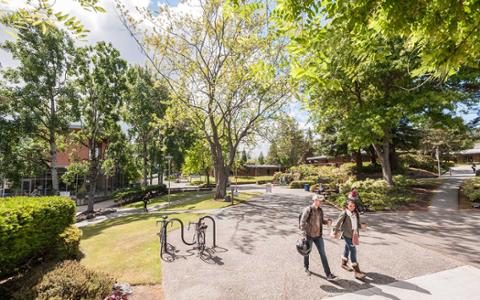
Student Body President looks forward to the year ahead
Sean Keller
Hello and how are you? I’ve been asked to write about what student government has planned this year. First, I can’t express how honored I am to be your President this year. I’m truly looking forward to a challenging and productive year.
I’m currently working with the bookstore and soon with the faculty to increase both the amount of text-books on the “buy back” list and the amount of used text-books available for classes. If you aren’t familiar with the “buy back” list, you may be missing out on a lot of returned money. Email me at skeller@shore. ctc.edu and I’d be happy to talk with you about any interest.
You can look forward to a searchable database on the student server to locate other students selling or buying text-books. Think of it as an electronic version of our current billboard system for trading used books. We plan on the board being cleared every quarter, so you know that the postings are current.
Parking! We have been working at new approaches to parking for a couple of years now, but an idea I had two years ago seems to be getting some interest or concurrence. I have agreed to head a parking task force composed of students from my economics class, and I am confident that we will come up with some new ideas. I will keep you updated in these Ebbtide pages.
Get Out the Vote is an event that our Legislative Director is holding. There will be candidates from our local elections, performances from our own campus talents, and giveaways from radio station 107.7 The End. The event will be held the day before elections on the first. See you there. Please get out and vote this November 2nd. It truly does matter.
Each quarter I will be addressing the student body in the canteen. There will be food and drink offered as well as some entertainment. My vision is of a community meeting. It will be an information session as well as an opportunity for you, the student body, to let Student Government know what is on your mind. It has been my experience that students who ask questions find answers. Sounds simple and trite, but there are services on this campus that I’m certain you don’t know about. It is my job to know and I’m here to assist you. It is part of my core values to be of service to others and help them realize their passions. Please let me know what we can do for you in Student Government. We are in the foyer of the PUB (room 950).
Well, we are into the fourth week already and by now you should all be pretty busy. I just wanted to greet you for the first time this year. Have a fantastic day.
Although we are here to learn about the world around us, we should remember to take the time to understand ourselves. Inside of each one of us, is the passion that makes great things appear to all of us.
So, I’ll leave you with a quote from Rumi, the great Sufi poet::
“You seek knowledge from books. What a shame! ...
You are an ocean of knowledge hidden in a dew drop...”
I-884: A tax increase to fund education
Jessica McDaniel Staff Reporter
As important as the presidential election is this November, don’t forget to cast your vote on I-884. If I-884 is passed, it will likely affect everyone who reads this paper. It could determine whether or not you are admitted to a four-year college, accepted into the program of your choice, or whether you can afford to put your children in preschool. The cost is an extra 1 percent tax on all your taxable purchases.
The purpose of I-884 is to increase high school and college graduation rates by increasing teacher support and training, and targeting high-risk schools and students. I-884 would create an education trust fund for Washington State. The fund would be used to reinstate previously suspended teacher cost-of-living raises, add support staff to K-12 schools, and increase the admission capacities of Washington State colleges (it would help eliminate the current admission backup).
The money that would go into the trust fund will come from a 1 percent retail sales tax increase. That’s an extra penny of sales tax for every dollar that Washington residents spend on retail goods. The estimated revenue from this tax increase is about $1 billion in 2005. In the first five years the tax is estimated to generate $4.7 billion.
Currently, the state retail sales tax is 6.5 percent. It raises about $7 billion for the state general fund each year. The increase would raise the sales tax to 7.5 percent which, when combined with local taxes, makes the total sales tax anywhere from 8.3 percent to 8.9 percent or more depending on which city and county you are in.
The total amount of extra money consumers would spend on sales tax depends on the amount of taxable goods they purchase. The Washington voter’s guide online says the estimated contribution from a family making the average state income of $50,000 will be about $215 each year.
Critics of the plan note that increased spending does not automatically translate into better student performance. The argument against the initiative in the online voter’s guide says education spending has been increasing steadily over the years, with no corresponding improvement in student performance. Washington students currently rank 34th in the nation on standardized testing; only 16 states scored lower.
There’s no doubt that education could be better funded. The teacher cost-of-living raise that was approved in initiative 732 was suspended by the legislature for the ‘03-‘04 and ‘04-‘05 school years because there wasn’t enough money to pay the increased wages. But is the solution an increase in sales tax that would give Washington the highest rate of sales tax in the nation?
Not only would I-884 fund 1-732, it would also fund enrollments for low-income children in a new early-education program, and fund more enrollments in Washington colleges. Over the next five school years, no less than 25,000 new state-funded higher education full-time equivalent (FTE) students will be funded. Each FTE give a college the ability to enroll one more student full-time.
Currently, the University of Washington and Washington State University have been having trouble accepting transfer students from Washington community colleges, because of a shortage of this kind of funding. The 25,000 new FTE’s will be divided between the universities and community colleges with more FTE’s going to high-demand programs such as nursing. With the extra FTE’s the universities will be able to enroll more community college transfer students in the future.
Giving students a better education benefits everyone. However, $1 billion per year is a lot of money to ask of consumers at once. This would be the largest tax increase since 1983.
|
Faculty members meet to discuss administration
Chaim Eliyah
A & E Editor
There’s a lot going on between the administration and faculty at Shoreline Community College. An open meeting which included non-staff members was held Wednesday by the Faculty Senate to discuss the practicality of holding a vote of no confidence in the leadership of President Holly Moore. Students and faculty alike have questioned the rationale for providing Moore with a $25,000 raise in July, and other issues have been raised regarding the leadership of the current administration.
There were a range of motions discussed at the meeting all having to do with the same issues. Ideas included were: conducting instead a vote of censure (which is not as severe as the vote of no confidence), performing a poll of present members to determine the feasibility of the action, or tabling the motion for a future date. However the main issue discussed was whether or not to perform a vote of no confidence. Essentially, it was a vote to vote.
When voting, most of those present were undecided as to whether or not they wanted to pursue such drastic action. Another motion was introduced to submit a list of concerns to the President’s office. One speaker raised concern as to whether this was a problem of administration or of Moore in particular. Others present thought that acting quickly was obstructive to progress and perhaps it would be best to “hold [the matter] over their heads for a while.”
But the matter has been held for a while already. According to the summer 2004 edition of the Ebbtide, in May many faculty members expressed concern for the general morale of the college by saying that the college was suffering from inadequate leadership and a lack of communication. Although no specific instances were voiced either then or at the present meeting, it seems that several faculty members are highly concerned about something.
Highlighted concerns with Moore’s leadership in particular include sensitivities regarding instances in which certain people have been provided with opportunities unavailable to all faculty members. To generalize, the Faculty Senate Council has observed specific occasions that personal acquaintances of Moore have received personalized benefits. By contrast, those who do not stand in good favor with the President have had their character attacked personally, their issues ignored, and have been dismissed as being merely negative thinkers. Apparently some staff members have been afraid to speak on these issues.
Someone said that they knew people whose jobs were threatened regularly if they didn’t complete various forms in violation of state rules. Instructor Tasleem Qaasim said specifically that she had undergone two years of harassment during which nobody spoke up or supported her. She noted that people in leadership positions, representing an entire school, receiving increasing salaries for actions that hurt people is positive reinforcement for bad behavior.
Other issues with the administration in general included economic and budget concerns, concerns about a possible double standard in terms of politics here at the college, and also reservations about neglect of students’ needs such as parking and childcare, which some feel should be within the lines of responsibility of the college. Many other issues are present – too numerous to list in this article.
This is not just a matter of isolated complaints from a few faculty members; these issues have been subjected to the intense consideration of faculty government over the course of several meetings; and the way it looks, it’s likely to continue for some time. The Faculty Senate will hold another special meeting after receiving a response from the President.
Students pay high prices for textbooks
Chaim Eliyah
A & E Editor
$305.50.
That was my total after selecting only the oldest, cheapest books available from our beloved Shoreline Community College Bookstore. I went back through my order and made sure that I hadn’t added anything extra or mistakenly, heaven forbid, bought a new textbook. No, this was correct. One-third of what I had spent on tuition, I would be spending on books. If for some reason I had needed all-new books, the total would have been $356.25.
OK, in all fairness, the current price of gold is slightly more expensive: $406.50 per troy ounce. But apparently the people who publish these things have forgotten that most of us struggling through college need to pay for things like food and clothing. We can’t eat the paper. And book covers aren’t exactly in fashion for fall.
This has been a problem for students across the nation year after year. An article from the second edition of the Ebbtide in Fall, 2001 reveals the whole problem seems to lay on the publishers themselves; instructors must order the best books available in-print and bookstores must stay in business – that’s all they can do.
The publishers, meanwhile, see fit to come out with new editions every year – sometimes less – that are hardly much different than the original. As soon as they begin printing these new editions, the old ones become nothing more than, well, used books. They are relegated to obsolescence simply because of a few minor changes. For example, a book entitled “Race, Class, and Gender,” published by Wadsworth, was recently replaced with a new edition after only a year. The new edition has replaced only five of the sixty-four original articles with new ones, some extra historical information was added, and the publisher proceeded to raise the price another ten dollars.
There is some recourse for students. Internet sites for students such as www.cheap-college-textbooks.com, www.bigwords.com, www.amazon.com, and www. directtextbook.com help students to compare prices and select the best deal. Also, many students have been posting their old textbooks for sale on campus, which helps other students considerably. These postings can usually be found around campus on billboards and such. And one thing that might help the situation, according to the bookstore’s buyer, is for students to talk to their professors and ask them to use the same textbooks as much as possible.
The Bookstore, for its part, offers 50 percent of the new price for textbooks they will reuse, and 10 to 30 percent for textbooks they will not use again. They will be offering a buyback at the end of fall quarter, Dec. 13, 14, and 15, from 8 a.m. to 6 p.m.
The situation itself doesn’t seem likely to change because either a) nobody has brought the problem to the publishers’ attention or b) they seem to be ignoring it. A quick examination of the Thompson Publishing Online Press Release Room for the last year reveals nothing about their concern of cost to students. There was an article, however, relaying “exponential growth for four straight years” to the stockholders as of March 8. Well, that was in a search for “prices.” As the website told me, “Your search for [cost to students] produced 0 results.”
|